Global enterprise payment orchestration · registered MSP/ISO of Elavon, Visa & Mastercard
Dual-rail payment orchestration, secured for the post-quantum era
PaychainX is the orchestration and post-quantum proof layer we built: an intelligent API router with tokenization, settlement, and a tamper-evident audit trail. It connects to CyberSource for card processing, is in pilot with Propelr, and is partnered with Zero Hash for stablecoin settlement. Every payment is sealed with a post-quantum-ready cryptographic proof, the differentiator no legacy processor offers.
Registered MSP/ISO · Elavon · Visa · MastercardGlobal edge networkConnected to CyberSourceZero Hash + Propelr partnersPCI-DSS alignedAML / KYC readyTamper-evident auditML-DSA-65 signed proofs live
208+
transactions orchestrated in the reference environment
~2.1 ms
median gateway routing overhead per request
100%
payments sealed with a SHA-256 audit proof
Figures reflect the PaychainX reference/sandbox environment, shown for demonstration. No production credentials or live cardholder data are exposed on this site.
Most gateways move transactions. PaychainX governs, abstracts, orchestrates, and proves them.
A complete gateway, not a single feature
PaychainX runs the full transaction lifecycle in production today. Post-quantum is the newest layer on top of an already enterprise-grade platform.
Intelligent API router
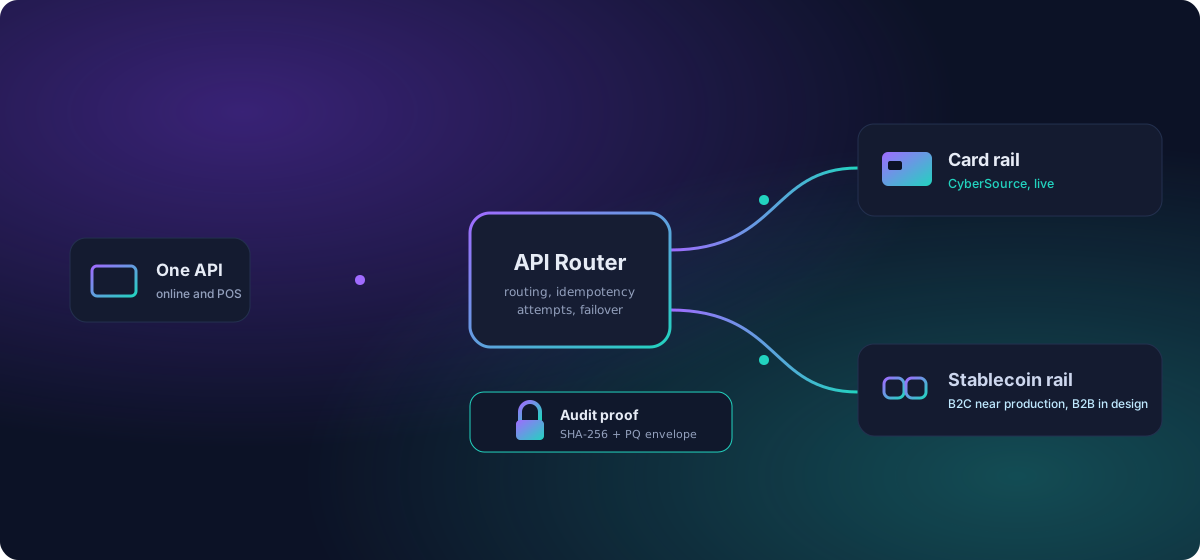
One API. The router selects the right processor and rail per transaction, with retriable payment attempts and processor failover. Orchestration, not just a passthrough.
Dual-rail orchestration
Route the same payment intent across the card rail (live via CyberSource) and the stablecoin rails (settled by Zero Hash, B2C nearing production, B2B in design), a governed layer bridging traditional and digital settlement.
Tokenization & vaulting
Card data is replaced with a token at the edge (card_token). The PAN never touches merchant systems, shrinking PCI scope.
Omnichannel acceptance
One gateway for online (channel: api) and card-present terminals (PAX A920 Pro, with terminal and device identity), with unified reporting across both.
Reliable signed webhooks
HMAC-signed events with automatic retry and full delivery tracking (attempts, HTTP status, delivered or failed), so merchants never silently miss a payment update.
Reporting & reconciliation
Daily transaction aggregates per processor, settlement lifecycle, and an admin search API over the full payment history with pagination.
One integration, every rail, under the hood
A merchant integrates once. Behind that single API, a router normalizes every payment, selects a rail, runs it through a uniform adapter, and seals the result in a tamper-evident proof. Here is exactly how it works in the gateway today.
The rails, and exactly what is live
PaychainX is the orchestration and post-quantum layer. CyberSource is the connected card processor, Propelr is our pilot partner, and Zero Hash is our stablecoin settlement partner. Every rail implements the same adapter contract, and we label precisely what is live versus on the roadmap.
Card rail, via CyberSource
sale, capture, void, refund with AVS, CVV, and risk scoring
Live
Propelr partner pilot
maps partner terminal sale requests onto the card rail
In pilot
Stablecoin rail, B2C, via Zero Hash
consumer stablecoin settlement, integration nearing production
Near production
Stablecoin rail, B2B, via Zero Hash
business-to-business stablecoin settlement, in design and scoping
In design
Uniform rail adapter
Add a rail by implementing one interface. The router never changes.
One function resolves a normalized payment to a rail.
function resolveProcessor(preferred = "cybersource") {
switch (preferred) {
case "cybersource":
return new CyberSourceAdapter(); // live
case "bank_rail":
return new BankRailAdapter(); // roadmap
default:
throw new Error("Unsupported processor");
}
}
Payment sources the router accepts:
sandbox_cardcybersource_transient_tokenbank_token
Safe retries by design, idempotency
Networks fail and clients retry. The gateway guarantees a retry never creates a second charge. Every POST /v1/payments/* requires an Idempotency-Key, and the body is fingerprinted so reuse is detected exactly.
requestHash = SHA-256( canonicalize( body ) )
same key + same body replays the stored response (x-idempotent-replay: true)
same key + different body 409 IDEMPOTENCY_CONFLICT
key still processing 409 IDEMPOTENCY_IN_PROGRESS
missing key 400 IDEMPOTENCY_KEY_REQUIRED
Merchant onboarding, compliance, and dashboard
Near production
Merchant self-onboarding with identity and business verification, and a merchant dashboard for activity, settlements, and reporting. UI and UX are roughly 95 percent complete and in the production phase.
Merchant onboarding
guided self-onboarding flow and merchant identity (MID) provisioning
95%
KYC, identity verification
know-your-customer checks on the onboarding path
95%
KYB, business verification
know-your-business checks for merchant entities
95%
Merchant dashboard, UI and UX
activity, settlements, reporting, API keys, and webhooks
95%
The differentiator
Post-quantum-secured payment proofs
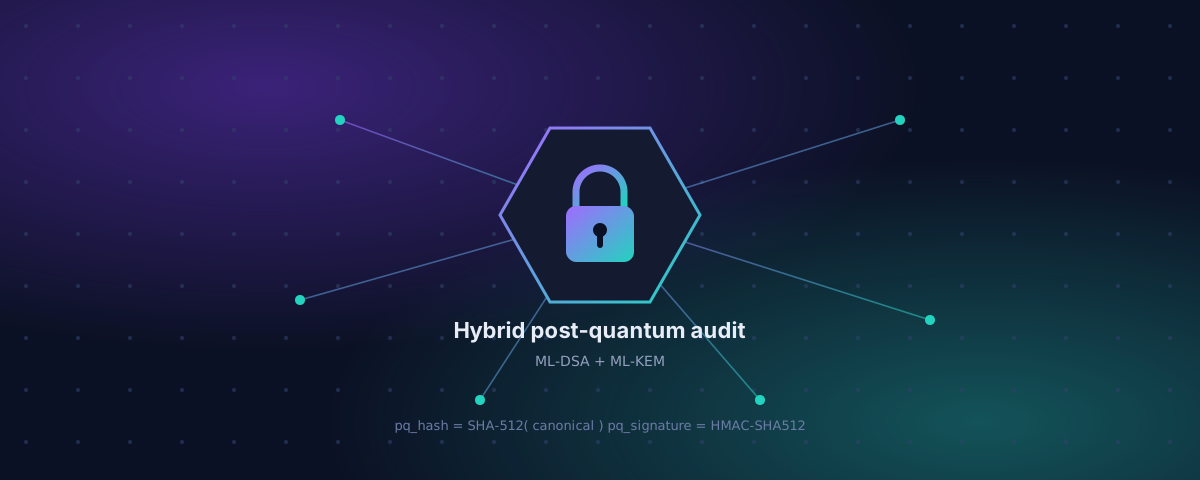
Every PaychainX payment emits a SHA-256 proof (proof_id: pq_…), an immutable, independently verifiable record of what happened. The gateway sidecar now signs that proof with ML-DSA-65 (FIPS 204), the NIST post-quantum signature, independently verified valid = true, so audit trails stay trustworthy even against a quantum adversary. No card processor on the market offers this today.
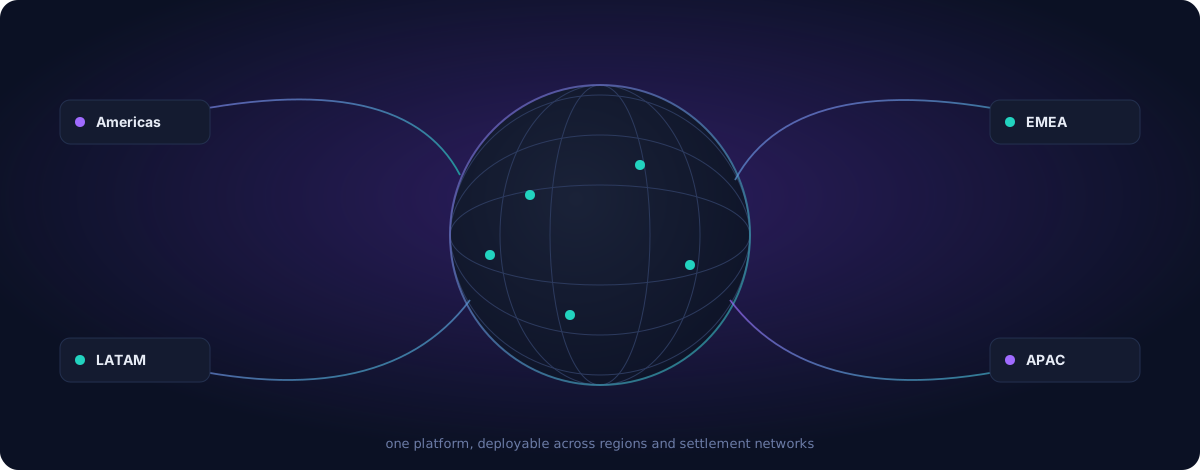
PaychainX is processor and rail agnostic by design, so a single integration can serve enterprises, banks, and governments across regions and settlement networks. The production gateway already runs behind a global edge network with TLS at every hop.
🌐
Global edge network
Requests are served over HTTPS behind a worldwide edge, keeping routing overhead low wherever the merchant or terminal sits.
💱
Cross-border and multi-currency
The canonical request carries currency on every transaction, the foundation for cross-border acceptance and multi-currency orchestration.
🏛️
Enterprises, banks, governments
Deploy as a license, a white-label gateway, or internal routing and settlement infrastructure for regulated, high-assurance markets.
Regions shown represent target deployment reach. PaychainX is a registered MSP/ISO of Elavon, Visa, and Mastercard. Cross-border, multi-currency, and additional settlement rails are a mix of live and roadmap capabilities, labeled as such across the site.
Built for the controls banks require
We separate what is live today from what is on the roadmap, with no overstated production claims.
Live today Operational
TransportTLS 1.2 / 1.3
Card dataTokenization / vaulting
AuditSHA-256 tamper-evident proofs
WebhooksHMAC-signed + retries
Admin APIKey auth · 401 enforced
InfraUbuntu · Nginx · PM2 · UFW
Roadmap Planned
PCI-DSS certificationIn progress
ML-KEM key exchangeKyber, roadmap
Blockchain / ACH rail GAExpanding
AML / KYC (DID)Integration
Secrets managerPlanned
SOC 2 alignmentTargeted
Ready to evaluate PaychainX?
Walk the live transaction demo, inspect the audit proofs, and see the post-quantum signing in your own browser.